
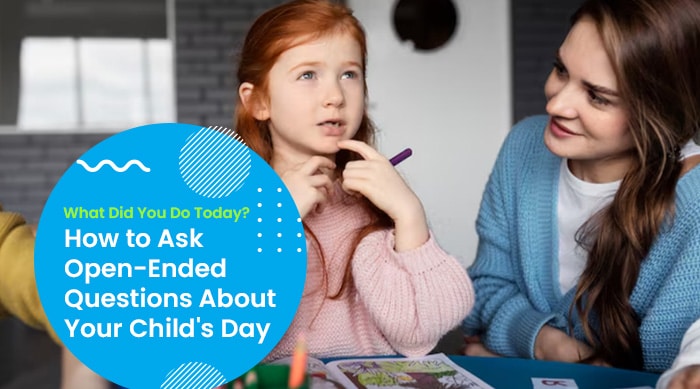
What Did You Do Today? How to Ask Open-Ended Questions About Your Child’s Day
It’s the universal after-school ritual. You pick your child up from school or sit down at the dinner table, bursting with anticipation to hear about their day. You lean in, smile, and ask the classic question: “What did you do today?”
The response? A mumbled, one-word answer: “Nothing.” Or perhaps, if you’re lucky, “Fine.” As parents, it can be incredibly frustrating to feel locked out of our children’s daily lives. You want to connect, understand their world, and know how they are navigating school, friendships, and their emotions. But closed or overly broad questions often lead to conversational dead-ends.
The secret to cracking the communication code isn’t asking more questions—it’s asking open-ended questions. By shifting how we approach these daily check-ins, we can transform a repetitive, frustrating routine into a meaningful, connective conversation.
Why “What Did You Do Today?” Usually Fails
To understand how to fix the problem, we first need to understand why the standard approach falls flat.
When children spend seven to eight hours at school, their brains are on overdrive. They are processing academic lessons, navigating complex social dynamics, and managing their energy. By the time they see you, they are often experiencing cognitive fatigue.
When you ask a broad, sweeping question like “How was your day?” or “What did you do today?”, it requires a massive amount of mental effort for a child to:
- Chronologically sort through eight hours of events.
- Filter out what is interesting or relevant.
- Formulate a cohesive narrative.
Instead of doing that heavy lifting, their tired brains opt for the path of least resistance: “Nothing.”
Furthermore, closed questions (questions that can be answered with a simple “yes” or “no”) like “Did you have fun today?” or “Did you eat your lunch?” don’t invite conversation. They act as checkboxes. Once checked, the dialogue is over.
The Power of Open-Ended Questions
Open-ended questions are queries that cannot be answered with a simple “yes,” “no,” or one-word response. They require thought, description, and personal reflection.
When you use open-ended questions with your child, you unlock several developmental and emotional benefits:
- Encourages Critical Thinking: Children have to evaluate their day, identify specific moments, and articulate their feelings.
- Builds Vocabulary and Language Skills: Describing events, emotions, and social interactions helps children practice complex sentence structures and emotional vocabulary.
- Strengthens the Parent-Child Bond: It shows your child that you are genuinely interested in the nuances of their life, not just looking for a status report.
- Validates Their Experiences: It gives them a safe space to share both their triumphs and their struggles without fear of immediate judgment or lecturing.
20 Open-Ended Questions to Ask Instead
The best open-ended questions are specific, low-pressure, and focused on different angles of your child’s day—social, emotional, academic, and humorous.
Here is a breakdown of targeted questions you can use to get the conversation flowing:
Questions About Social Connections and Friendships
Navigating peer relationships is a huge part of a child’s day. These questions help you understand their social circle without sounding nosy.
- “Who did you sit next to at lunch today, and what did you talk about?”
- “What games did people play at recess today?”
- “Did anyone do something really funny or silly today?”
- “If you could swap seats with anyone in your classroom, who would it be and why?”
- “Did you see anyone being helpful or kind to someone else today?”
Questions About Learning and Classroom Activities
Instead of asking if they passed a test, focus on their engagement and curiosity.
- “What was the most surprising thing you learned today?”
- “If you were the teacher tomorrow, what would you teach the class?”
- “What is a book or a story your teacher read today?”
- “What was the hardest thing you had to do today, and how did you handle it?”
- “What made you feel really smart or proud of yourself today?”
Questions for Emotional Check-Ins
These questions allow your child to express a full range of emotions, teaching them that it is okay to have bad moments alongside good ones.
- “What part of the day made you feel the happiest?”
- “Was there a time today when you felt frustrated or bored?”
- “What is something you’re looking forward to doing at school tomorrow?”
- “If today were a movie, what would the title be?”
- “Did anything happen today that made you feel confused?”
Fun and Creative Conversation Starters
Sometimes, a silly hypothetical question is the perfect way to break the ice and get a tired child laughing.
- “If a spaceship landed at your school today, who would you want the aliens to take with them?”
- “What was the best smell or sound you noticed at school today?”
- “If you could change one rule at your school, what would it be?”
- “Which area of the school is the most magical, and why?”
- “If your day at school was a color, what color would it be?”
4 Strategies for Successful After-School Conversations
Changing the questions you ask is only half the battle. How and when you ask them matters just as much.
1. Timing is Everything (Respect the “Decompression Chamber”)
Imagine walking through the door after a stressful, high-stakes day at work, and someone immediately starts firing specific questions at you. You’d likely feel overwhelmed. Kids feel the same way. Give your child a “decompression chamber” period. Let them have a snack, change their clothes, or just sit in silence during the car ride home. Often, if you leave them alone for 20 to 30 minutes, they will voluntarily start sharing details on their own terms.
2. Practice Active Listening
When your child does start talking, put down your phone, close your laptop, and look at them. Use reflective listening to show you are engaged.
Example: If they say, “Max wouldn’t let me play blocks with him,” instead of immediately offering a solution (“Well, go play with someone else”), reflect their feeling: “Oh, that sounds frustrating. You really wanted to build today.” This keeps the doorway of communication wide open.
3. Normalise Mistakes and Bad Days
If you only praise the good grades and happy moments, your child may hide their struggles. Make it safe to talk about failures. Share a small mistake you made during your day first. This models vulnerability and shows them that perfection isn’t the expectation.
4. Don’t Force It
If your child is clearly exhausted, cranky, or shutting down, don’t force the conversation. Pushing too hard turns a potential connection into an interrogation. Respect their boundaries and try again later during dinner or right before bedtime, which is often when kids feel most talkative.
Final Thoughts: Building a Lifelong Habit
Moving away from “What did you do today?” requires a bit of effort and intentionality, but the payoff is immense. By utilising specific, creative, and open-ended questions, you aren’t just getting a recap of their school day—you are building a foundational habit of open communication.
When your child learns that you are a safe, attentive, and non-judgmental sounding board for the little things (like recess games and school lunches), they will know they can trust you with the big things as they grow into adolescents and young adults.
Tonight at the dinner table, try picking just one open-ended question from the list above. Sit back, listen closely, and enjoy watching your child’s world open up to you.