
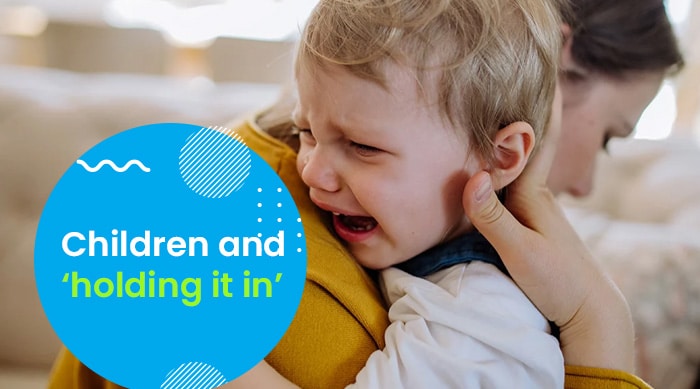
Children and ‘holding it in’
Although it’s hardly the most pleasant of subjects, many parents need to deal with a child who suddenly decides they’re going to ‘hold in’ their pee or poo for as long as possible. This is sometimes called ‘stool withholding’ or ‘poo holding’ though it can also affect urine.
Children and ‘holding it in’
It’s something that we also see, at times, with some children in our Dayton daycare centre.
Symptoms
- If your young child is producing extremely smelly wind or thickened brown pee, which might also be unusually smelly, then there’s a fair chance they’ve decided to ‘hold it in’ for as long as possible.
- There are other possible explanations for the above symptoms but this cause should also be an early suspect, particularly with children in the age-range 2 to around 4 years, though it can sometimes go on to older ages, notably in girls.
- Other symptoms that your child has fallen out of love with the toilet might include them complaining of belly aches, rocking around in their chair, fidgeting badly, sitting cross-legged more than usual and struggling to concentrate.
Causes
Child psychologists have identified a very large number of causes – far too many to list and discuss in this article. Some of the more commonly identified are:
- traumas arising from potty training and subsequent fear of defecating or pooing;
- bodily control – some children engage in a battle with their own bodies to see who is in control and holding back their pee and poo can be part of that. It can also be their way of getting back at parents who they can see becoming concerned (meaning more attention for the child) if they’re not going to the loo;
- fear of pain. Some children may, at times, find pooing or peeing a little painful and they become afraid of it accordingly;
- stress – this can happen as a reaction to stress, such as a divorce or changing daycare centre etc.
Effects
Apart from some of the issues mentioned above, the net effect of this on a child is typically not serious. However, if the behavior or condition is taken to excess it can increase the risk of urinary infections, lead to true constipation, and contribute to other related complications.
For these reasons, careful identification of the underlying cause and prompt, appropriate treatment are essential to prevent escalation and to support the child’s long-term health and well-being.
Treatments
As the underlying causes of this condition can be highly varied and multifactorial, there is no single universal treatment that will be effective in every case.
In the majority of children, however, the problem gradually resolves on its own as they grow older and pass through this stage of development. It is therefore typically a normal and minor, albeit sometimes slightly alarming, developmental phase rather than a sign of a serious disorder.
Parents might try;
- making peeing and pooing sound as normal as possible. They can be made funny and the child should be encouraged to see them as ‘no big deal’;
- staying with the child while they are in the loo. Try to avoid making this of the “I’m here to help or hold your hand” variety but rather just an extension of a normal chat;
- encourage the child to imagine what their body is doing and apply little fun made-up noises they can use whilst ‘going’.
We have used all of these very successfully in our Dayton daycare centre.
Things NOT to do:
- use laxatives – unless these have been approved in advance by a doctor;
- show impatience or try to apply pressure to the child to ‘go’ as soon as possible;
- make it seem like their holding-in is somehow naughty, requiring a telling-off or bad behaviour sanctions.
In a few and fortunately very rare cases, the condition or rather tendency, may continue for extended periods of time, despite all parental efforts to overcome it. In such situations, a quick chat with your doctor would be advisable.